
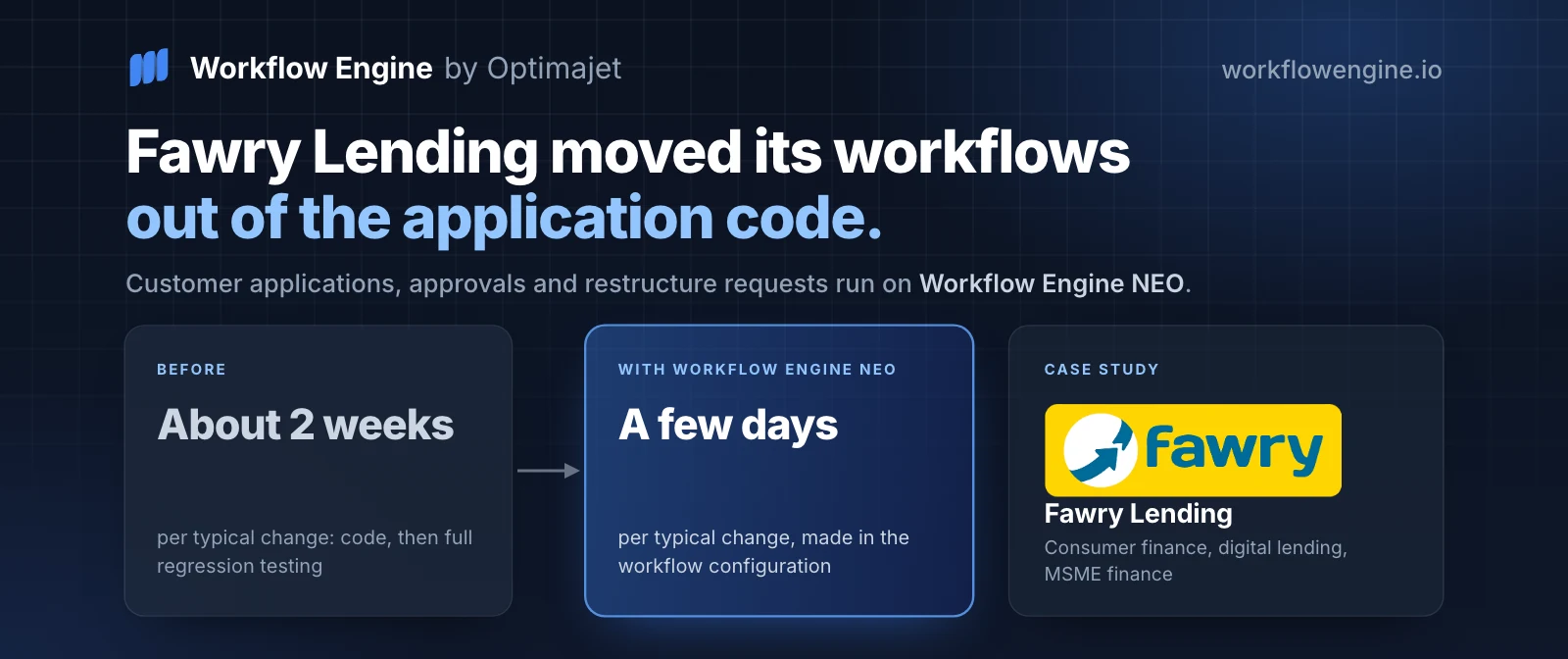

Fawry Lending is part of Fawry, the Egyptian payments and financial services company. It works in consumer finance, digital lending and MSME finance, which is lending to micro, small and medium businesses. Its lending work covers customer applications, approvals, loan creation and restructuring. As the business grew, its workflows came to involve more teams, including Operations, Credit and Customer Service.
About seven of those workflows run on Workflow Engine NEO by Optimajet today, or are planned for it. A typical workflow change used to take about two weeks. Now most changes are done within a few days. Fawry Lending's team wrote the case study behind this article, and every figure in it is theirs.
Workflow rules lived in the application code
Before Workflow Engine NEO, Fawry Lending's workflow logic was hard-coded in the application. Every change needed the Technology team, even when a request only changed the routing or an approval step.
The workflows were part of the main application code, so every change also went through full testing and regression testing. A typical workflow change took about two weeks, from the request to production.
Assignments were the second problem. In a complex approval flow, it was hard to manage which team or user was responsible for a request.
The old approach did the job. Fawry Lending wanted workflows that were more flexible, easier to maintain and less tied to static application code.
Why Fawry Lending chose Workflow Engine NEO
Fawry Lending looked at another workflow product before it chose Optimajet. Four capabilities decided the choice: easy .NET integration, flexible workflow configuration, flexible licensing and multitenancy.
Workflow Engine NEO let Fawry Lending take workflow management out of the main lending application. The workflows still connect to the existing .NET environment. The configurable model was especially valuable, because Fawry Lending wanted to make most workflow changes in the configuration, without touching the core application.
Workflow Engine NEO comes in four editions. Workflow Engine NEO Subscription is an annual license, and the Business, SaaS and Enterprise editions are perpetual. The pricing page lists each edition of Workflow Engine NEO and its price.
A separate workflow service next to the lending platform
Fawry Lending runs Workflow Engine NEO as a separate workflow service, connected to its lending platform. The first integration took more than a month. After that, the first production workflow took more than two weeks.
The first build cost about as much effort as writing the workflow logic by hand. The difference showed later. The team began to change workflows in the configuration, instead of changing application code for every adjustment.
Three scenarios run on Workflow Engine NEO today. The main one is customer application processing. A request moves through stages, teams and approval levels until it reaches a final decision. The other two are approval flows and restructure requests. Registration flows use the same dynamic workflow configuration.
Most workflow steps are now set in the configuration, and so are the assignments to departments, teams and users. The actions on a request include Approve, Reject, Send Back, Reassign and Save.
The Technology and Development team maintains the workflow configuration together with the Product team. For Fawry Lending, the value is flexibility. The configurable model gives far more of it than the static implementation it replaced.
One workflow platform for every business unit
Multitenancy is an important part of Fawry Lending's workflow architecture. Each business unit or product can have its own workflow configuration, with its own processes and approval rules. They all run on one common workflow platform, so Fawry Lending keeps no separate workflow environment for each of them.
Fawry Lending names three benefits. New products and business units are onboarded faster, the platform scales better, and maintenance takes less effort. Without multitenancy, every business unit or product would need a workflow environment of its own. That means more operational work, and it makes growth harder.
In Workflow Engine NEO, multitenancy is ready for production, and the tenant-aware HTTP API ships with the product. The page on multi-tenant workflow architecture in Workflow Engine NEO shows how it works. It covers the physical, logical and hybrid isolation models, and how to register a tenant without a restart.
What changed for the teams
| Area | Before Workflow Engine NEO | With Workflow Engine NEO |
|---|---|---|
| A typical workflow change | About two weeks, from request to production | A few days |
| Where a change is made | In the application code, then full regression testing | In the workflow configuration, for many changes |
| Who makes the change | The Technology team, for every change | The Technology and Product teams, often with no core development |
| Who is responsible for a request | Hard to manage in complex approval flows | Much easier to see, down to the team or user |
The release cycle for workflows is much faster. Many changes no longer wait for core application development, and keeping the workflows up to date takes much less effort. Tracking a request and finding the cause of a problem are easier too. Workflow status and assignments are managed more clearly.
“The most visible improvement has been the ability to manage workflow changes dynamically.”
Fawry Lending, in its case study
Fawry Lending does not have enough data yet to measure a change in workflow bugs or errors. The case study gives no figure for them.
A recommendation for other .NET teams
Fawry Lending rates its overall experience with Workflow Engine NEO as very good. It gives the same rating to the documentation, the performance and the stability. The capabilities it values most are the four that decided the choice: flexible workflow configuration, easy .NET integration, flexible licensing and multitenancy.
“Fawry Lending would recommend Optimajet Workflow Engine to other .NET teams that need to manage changing and complex business workflows.”
Fawry Lending, in its case study
Its reasons are the configurable model, the straightforward .NET integration, faster workflow changes, multitenancy and lower maintenance effort. In Fawry Lending's words, together they make the engine “a strong option for organizations seeking to move away from static, hard-coded workflow implementations.”
About Fawry Lending
Fawry Lending is part of Fawry, an Egyptian payments and financial services company. Fawry was founded in 2008 and has been listed on the Egyptian Exchange since 2019. Fawry Lending works in consumer finance, digital lending and MSME finance. Read more about the group at fawry.com and on Fawry's LinkedIn page.